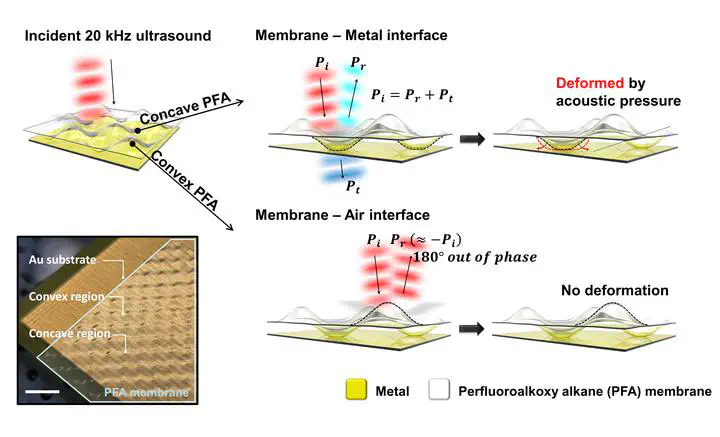
Implantable medical devices (IMDs) require sustainable and efficient energy sources for long-term operation. Ultrasound-driven triboelectric nanogenerators offer a promising solution by converting ultrasonic energy into electricity. However, their practical application is hindered by challenges in maintaining high output performance and stability. This study introduces an acoustic impedance mismatched triboelectric nanogenerator (AIM-TENG) that optimizes ultrasonic energy harvesting through controlled acoustic impedance variations. The AIM-TENG incorporates a patterned triboelectric membrane with concave regions that enhance vibration and convex regions that suppress it, achieving a ∼200% increase in short-circuit output current compared with a planar film device of identical size at an ultrasound intensity of 0.5 W/cm2, while maintaining this enhancement after a 100-million-cycle vibration test. In vivo implantation in rats demonstrated stable electrical output for six weeks, with efficient battery charging rates exceeding flat film-based designs. The integration of structural optimizations and material properties underscores the AIM-TENG’s potential as a reliable energy source for IMDs, offering insights into advanced ultrasonic device design for biomedical applications.

Young-Jun Kim
My research focuses generating static electricity by mechanical energy and, use it for biomedical applications.